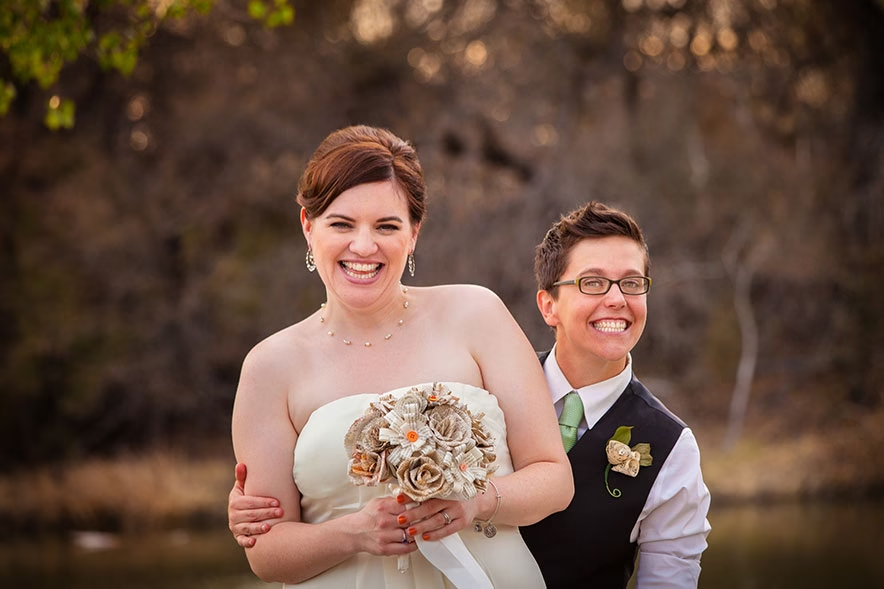

You’ve Built a Life Together. The Law Doesn’t Know That.
March 13, 2026
Lars Kushner Recognized by Lawyers of Distinction for Third Consecutive Year
April 10, 2026
Your Family Doesn’t Fit in a Box — Your Estate Plan Shouldn’t Either
Picture this: Your partner of 15 years is in the hospital, unconscious. The doctor needs to know whether to proceed with a risky surgery. You step forward — and are turned away. Not because you don’t love them. Not because you don’t know their wishes. But because, in the eyes of the law, you are a stranger.
For millions of LGBTQ individuals, unmarried partners, and people with chosen families, this nightmare is not hypothetical. Without proper estate planning, California law may default to blood relatives — even estranged ones — when it comes to healthcare decisions, inheritance, and financial control. The good news: a well-drafted estate plan can change all of that.
What Is “Chosen Family” — and Why Doesn’t the Law Recognize It?
Chosen family refers to the people you’ve selected to be your inner circle: a long-term partner, close friends, former roommates, community members, or mentors who function as family in every meaningful way. California law, however, largely doesn’t recognize chosen family in the absence of formal legal documentation.
Under the California Probate Code, if you die without a will or trust — what’s called dying ‘intestate’ — your assets pass according to a rigid hierarchy: first to spouses, then registered domestic partners, then children, parents, and other blood relatives. Your chosen family? They receive nothing, regardless of how intertwined your lives may be.
For same-sex couples who are married or registered domestic partners, some of these protections apply automatically. But for those who are unmarried, in non-traditional relationships, or relying on chosen family structures, the gaps are significant — and potentially devastating.
The Four Documents Every LGBTQ Person and Chosen Family Member Needs
Estate planning is not just for the wealthy or the elderly. It’s for anyone who wants the people they love to be protected. Here are the core documents that form a complete plan:
- Revocable Living Trust. A trust allows you to name exactly who receives your assets — including chosen family members — without going through probate. It also lets you designate a successor trustee who can manage your finances if you become incapacitated. Unlike a will, a trust is private and takes effect immediately upon incapacity.
- Pour-Over Will. This companion document ensures that any assets not formally titled in your trust still flow into it at death. It’s a critical backstop that closes planning gaps.
- Durable Power of Attorney. This document appoints someone — your partner, a trusted friend — to manage financial matters on your behalf if you’re unable to do so. Under California Probate Code § 4401, this authority can be broad or narrowly tailored to your needs.
- Advance Health Care Directive. This document names your health care agent (who makes medical decisions for you) and outlines your treatment wishes. Without this in place, California law determines who speaks for you — and that person may not be the one you’d choose.
Special Considerations for Same-Sex Couples and Unmarried Partners
Even with federal marriage equality secured by Obergefell v. Hodges, LGBTQ couples face unique legal vulnerabilities. Legal protections for same-sex couples are currently the subject of ongoing policy debate, and relying on federal recognition alone is no longer a risk-free strategy. Estate planning provides protections that exist independently of any court decision.
For unmarried partners — whether LGBTQ or not — the stakes are even higher. California does not grant inheritance rights to unmarried partners unless those rights are spelled out in a will or trust. This means a partner of 20 years could be entitled to nothing, while a distant relative inherits everything.
A comprehensive estate plan addresses this head-on. Your trust can specify exact distributions to your partner. Your power of attorney ensures they can manage your finances if you’re incapacitated. And your health care directive gives them legal authority to speak for you in a medical crisis.
Real Consequences of Not Planning
Without an estate plan, California courts step in — and they follow a script that wasn’t written with your life in mind. Here’s what can happen:
- Your estranged parents, not your partner, may inherit your home and bank accounts.
- Your biological siblings — some of whom may be unsupportive of your identity or relationship — could contest arrangements and tie up assets in court for years.
- Your partner may be excluded from end-of-life medical decisions, even if you’ve verbally communicated your wishes.
- Pets, shared property, and sentimental items may go to people who don’t know or care about their significance.
These outcomes are preventable. But only with action.
The Kushner Legal Approach
At Kushner Legal Corporation, we understand that estate planning is deeply personal — and that the law hasn’t always kept pace with the diversity of California’s families. Our practice was built to serve LGBTQ individuals, same-sex couples, unmarried partners, and chosen family structures with the same care and legal precision that every family deserves.
We help clients throughout Los Angeles, Beverly Hills, West Hollywood, and Palm Springs create plans that reflect their actual lives — not a one-size-fits-all legal template.
Ready to Protect Your Chosen Family?
Estate planning is one of the most loving things you can do for the people who matter most to you. Whether you’re starting from scratch or need to update an existing plan, we’re here to help.
Contact Kushner Legal Corporation today to schedule a consultation. Call us, visit our website, or reach out through our secure client portal — and take the first step toward protecting your chosen family on your own terms.